
Clarivore logo Clarivore

Recently Viewed Restaurants

The Challenge of Eating Out
With Food Restrictions

For the 85+ million Americans with food allergies or dietary restrictions, every restaurant meal requires trust. Here's what the research tells us.

Food Restrictions Affect Millions of Americans

16M
Adults
6.2%
+
4M
Children
5.8%
"About 16 million (6.2%) U.S. adults have food allergies. About 4 million (5.8%) U.S. children have food allergies." Asthma and Allergy Foundation of America, 2025

Beyond Allergies: Dietary Restrictions

0%
of Americans follow some dietary restriction
whether for health, ethics, or personal preference

Common Dietary Patterns

Gluten-Free 12%
Vegetarian 10%
Intermittent Fasting 10%
Pescatarian 6%
Low-Carb / Keto 5%
Vegan 4%

Many individuals follow multiple dietary patterns

"More than half of consumers (52%) battle to find food suitable for their requirements when eating out at restaurants... vegan consumers (46%) have a particularly hard time when purchasing food, followed by vegetarians (39%), and consumers on gluten-free diets (33%)." FoodNavigator-USA / Spoon Guru Survey, 2019

The Challenge of
Dining Out

Adult allergic reactions while dining out 31%
Pediatric allergic reactions while dining out 13%
"In the United States, between 2017 and 2019, 31% of adult and 13% of pediatric allergic reactions to food were estimated to occur while dining out." Journal of Allergy and Clinical Immunology: In Practice, 2021

Gluten-Free? Not Always.

Restaurant foods labeled "gluten-free" contain gluten 32%
"Gluten-free" pizza tests positive for gluten 53%
"Gluten-free" pasta tests positive for gluten 51%
"Of 5,624 'gluten-free' food items tested, 32% contained detectable gluten. Pizza and pasta were the worst offenders." Columbia University / American Journal of Gastroenterology, 2019
0%
of diners with dietary restrictions struggle to find compliant meals
at restaurants
"More than half of US diners with exclusion diets struggle to order meals that meet their dietary needs when eating out." Restaurant Dive / Spoon Guru Survey, 2019

When Dining Out Goes Wrong

0%
of fatal anaphylactic reactions occurred away from home
At restaurants, friends' homes, work, school, or college
"Evidence shows that a significant percentage of fatal anaphylactic reactions occur in eating out situations. Of the 63 fatal anaphylactic cases reported in a national registry in the US, the majority of lethal reactions (i.e., 48; 76%) occurred away from home, for example, at a restaurant, at a friends' home, or in work, school or college." Food Control Journal, "Risk management during eating out"

Celiac Reactions: Not Deadly, But Debilitating

0%
of celiac patients report symptomatic reactions
to suspected gluten exposure while on a gluten-free diet
24h
Median symptom duration
Ranging from 1 hour to 8 days of discomfort
"Repeated gluten exposure increases risk of small bowel cancer, lymphoma, osteoporosis, and infertility for those with celiac disease." PMC, "Association Between Celiac Disease and Cancer", 2020

Why "Just Tell Your Server"
Doesn't Work

Verbal communication fails more often than it works

0%
Reactions despite informing staff
An allergic reaction occurred despite informing restaurant staff of their food allergy
0%
Reactions despite calling ahead
Eating-out reactions occurred despite having called the restaurant before visiting or having informed the cook, chef or waiter
"Informing restaurant staff in the absence of allergenic ingredients declared on the menu only prevented allergic reactions less than 50% of the time." Journal of Allergy and Clinical Immunology: In Practice

The Training Gap

50%+
of restaurant staff have never been trained on food allergies or dietary restrictions
"Only 57% of restaurant employees have completed allergen training—even when it's available at their workplace." PMC, "Food Allergen and Gluten Training and Awareness Among Restaurant Workers", 2020

The Alarming Reluctance
to Speak Up

0%
Don't consistently alert staff about their allergy
Despite life-threatening consequences, many stay silent
"Paradoxically, declaring the allergy and seeking staff acknowledgment of the severity of the condition could make participants feel that they were perceived by staff as a nuisance. These dilemmas sometimes limited conversations and constrained customers' risk management." Food Control Journal
"Two major constraints to risk conversations were identified: being seen as 'fussy' or as a 'nuisance'. Language barriers, feelings of social embarrassment deriving from uneasiness about interrogating staff about allergen content of dishes, and unwillingness to disclose the allergy for fear of food venues refusing to serve them are major challenges that impede risk conversations." Food Control Journal

What Research Shows
Actually Works

Written allergen information outperforms verbal communication

"Choosing restaurants that declare allergenic ingredients on their menu was shown to be more effective than informing restaurant staff of their allergy." Journal of Allergy and Clinical Immunology: In Practice
"Prior research demonstrates that provision of clear allergen information in written form is a clear preference for consumers with food hypersensitivity when dining out." Begen et al., 2016

What Actually Works in Restaurants

"Restaurants with a designated person to answer dietary questions and a written plan for handling food restrictions show improved staff knowledge and customer outcomes." PMC, "Food Allergen and Gluten Training and Awareness", 2020

The Information
Restaurants Don't Have

0%
of restaurants lack complete ingredient lists
for all or most menu items
"Among managers, 55.2% reported that their restaurants had ingredient lists or recipes for all or most menu items, 18.4% reported ingredient lists for some menu items, and 25.3% reported having no lists." National Restaurant Manager Survey

The Menu Gap

0%
of U.S. restaurant menus mention "gluten-free"
Only 10% offer dedicated gluten-free menus

People With Food Restrictions
Dine Out Just As Much—Or More

Food Allergic Consumers Dine Out Just As Often
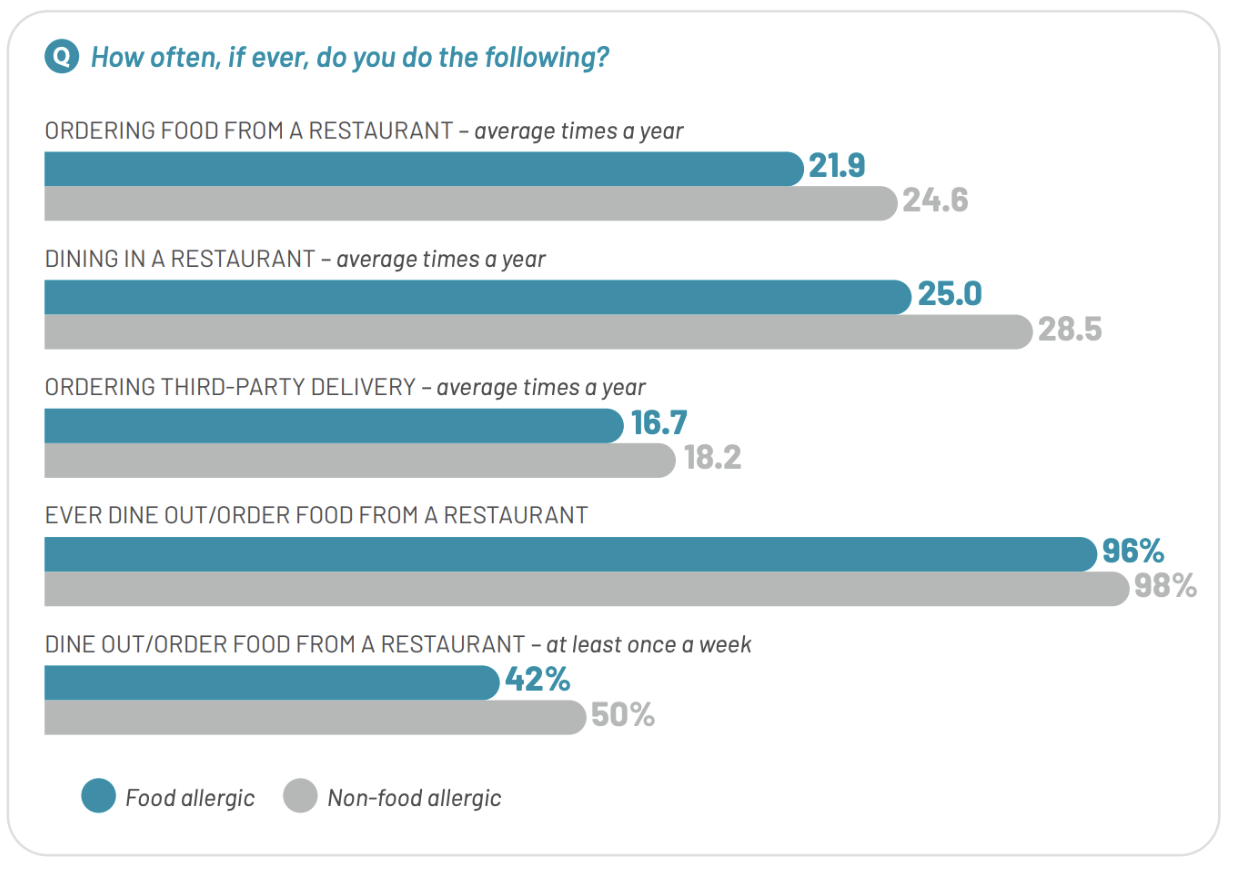
How often food allergic vs non-food allergic consumers dine out
"The majority (96%) of food allergic consumers dine out, dine in, or order food from restaurants at a frequency comparable to their non-food allergic counterparts (98%)." Food Allergy Canada, "Recipe for Success" Consumer Experience Report

Vegans & Vegetarians Actually Dine Out More

30%
Vegan/Vegetarian
Casual Dining Weekly
17%
All Adults
Casual Dining Weekly
21%
Vegan/Vegetarian
Fine Dining Weekly
9%
All Adults
Fine Dining Weekly
"Vegans and vegetarians dine out MORE than average Americans—30% visit casual dining weekly vs. 17% of all adults. 21% visit fine dining weekly vs. just 9% of all adults." YouGov Profiles, 2024-2025
0%
of people with celiac disease report being unable to eat at restaurants
due to contamination concerns
"Unlike other dietary restrictions, celiac patients often avoid restaurants entirely—not because they don't want to dine out, but because they can't trust the food will be safe." Beyond Celiac / Celiac Canada State of Celiac Survey

How Food Restrictions Shape
Restaurant Choices

Allergies Drive Restaurant Choices

86% say allergy influences loyalty, 66% choose restaurants based on allergen policy
"In fact, two-thirds of food allergic consumers say they often or always choose specific restaurants because of their allergen policy or the availability of ingredient information for menu items." Food Allergy Canada, "Recipe for Success" Consumer Experience Report

Allergic Diners Prioritize Allergy Safety Over Food Cost
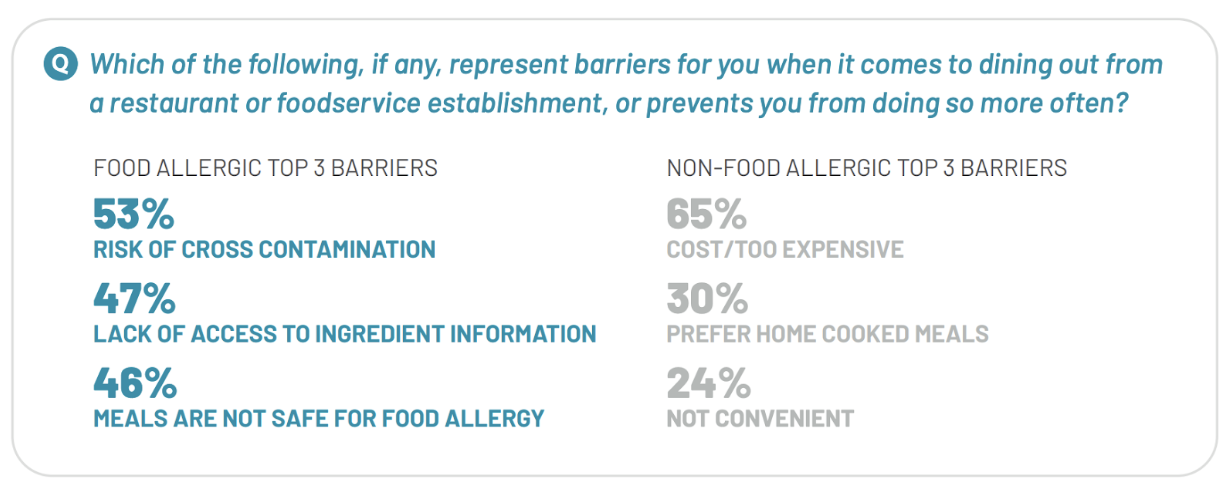
Top 3 barriers to dining out for food allergic vs non-food allergic consumers

The Satisfaction Gap

35
Vegan/Vegetarian
Satisfaction Score
43
All Adults
Satisfaction Score
"Despite dining out more, vegans and vegetarians report lower satisfaction than average diners—scoring 35 vs. 43 at casual dining establishments." YouGov BrandIndex, 2024
"The 'vegan veto vote': When one person in a group can't eat somewhere, entire groups choose different restaurants. Accommodating dietary restrictions doesn't just serve one customer—it serves their entire party."

Accommodating Restaurants
Earn Exceptional Loyalty

78% of Allergic Diners Return to Safe Restaurants

78% of food allergic consumers are loyal vs 66% of non-food allergic
"People with food allergy need to eat and are very loyal to establishments that provide them with a safe experience. Meeting their needs is important and good for business." Food Allergy Canada, "Recipe for Success" Consumer Experience Report
0%
of customers with dietary restrictions return to restaurants that accommodate them well
"If you can convince people you are making safe products, you will have a loyal customer for life." — Shelley Case, RD, gluten-free diet expert, via PMQ Pizza / Gluten Intolerance Group

The Market Opportunity

$8.1B
U.S. Plant-Based Food Market
And growing year over year
$13.67B
Projected Gluten-Free Market by 2030
Currently $7.75 billion

How Clarivore Makes
Dining Out Easier

Every feature is designed around what research shows actually works—for allergies and dietary restrictions alike

🔬

Multi-Source Verification

Trust data that's been cross-referenced, not guessed.

Every branded ingredient is researched across multiple online sources. We don't rely on a single database—our AI cross-references ingredient lists from retailers, manufacturers, and food databases. Whether you're avoiding peanuts or animal products, our AI identifies hidden ingredients across thousands of dishes.

Continuous Manager Verification

Accuracy maintained by those who know best.

Managers photograph their actual menus to confirm they match what's online. Every branded product requires a barcode scan. If a restaurant doesn't re-confirm monthly, they're removed. Managers confirm not just allergen info, but whether dishes are truly vegan, vegetarian, or gluten-free.

🎯

Clarity & Consistency

Same clear format, every restaurant, every dish.

No more deciphering cryptic menus. Every dish displays allergen information the same way—color-coded indicators personalized to your needs, so you know instantly what's safe. Personalized to your needs—whether that's a peanut allergy, celiac disease, or a vegan lifestyle.

💬

Direct Kitchen Communication

Talk directly to the people preparing your food.

Questions about cross-contamination? Clarivore enables direct communication with kitchen staff—no more playing telephone through servers who may not understand your needs. Ask about cross-contamination, shared fryers, or hidden animal ingredients like fish sauce or chicken broth.

Ready to Dine with Confidence?

Join the millions of Americans with food allergies and dietary restrictions who are finding safe, satisfying meals with Clarivore.